My next adventure: Tbilisi (Georgia) – May 2026

Nath

Day 4 (Georgia) – Diamond Bridge Accessibility

One of the top attractions to visit in Georgia is Kassland. This eco resort offers a range of activities from go carting to quad bikes, however the main draw for tourists is the famous Diamond Bridge which expands across the Dashbashi Canyon. At it’s heart is a suspended class building shaped into a diamond which has a cafe and an observation platform…

Unfortunately, during one’s visit, Kassland experienced a power cut meaning that the accessible entrance and lift down to the bridge were out of order.

Akin to Sophia in Bulgaria, some staff seemed to find it easier to try to lift the wheelchair up the steps to the entrance as opposed to opening the supply vehicle gate which is used as the accessible entrance. After entering said entrance, a winding ramp leads down to the Diamond Bridge…

It is at this point that a wheelchair user can descend a lift directly onto the Diamond Bridge. Despite the power cut the bridge offered panoramic views of the canyon and the surrounding the Caucasus Mountain range…

Day 3.5 (Tbilisi) – Mtatsminda Park

Overlooking the city of Tbilisi sits Mtatsminda Park which comprises of amusements, nature and restaurants. One is struck by panoramic views immediately after exiting either the funicular or cable car systems…

As one can see from the above, some restaurants face the view overlooking Tbilisi.

Attractions a giant ferris wheel and its also the location the Tbilisi TV tower which is looking a bit worse for wear as of 2026…

Unbeknown to one, it is also possible to catch the cable car from Shota Rustaveli Avenue. In most cases this is probably easier to access than the funicular. However, the accessible entrance appears not to be sign posted hence it is easily missed. It can be found on Vano Sarajishvili Street through an unassuming archway and a private car park…

For those who wish to ride said cable car, the full name is Rustaveli-Mtatsminda Cable car.

Day 3 (Tbilisi) – Funicular Accessibility

One of the most convenient ways to access the Mtatsminda Park is to use the Tbilisi Funicular. Unlike the Baku Funicular in Azerbaijan, this is wheelchair accessible. However, the difficulty is accessing the lower station as it may be necessary to navigate Soviet avenues and cobbled streets…

Upon entering the lower funicular station, one will easily find the accessible entrance and ramp to seamlessly enter the vehicle…

Although one can only access the bottom level, the ride provides panoramic views over the city of Tbilisi (providing that it is not busy)…

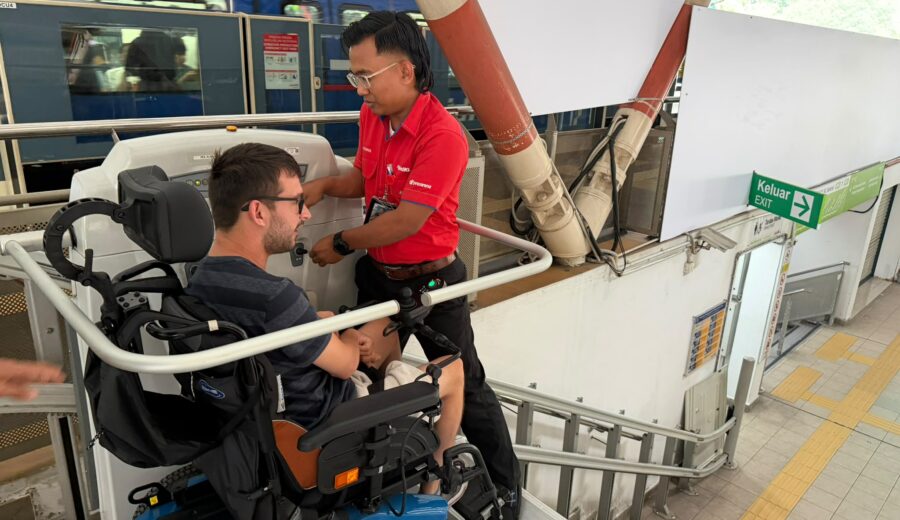
To exit the upper station, it is necessary for wheelchair users to utilise a stairlift hence it maybe prudent to check that it is working before you travel…

It is also worth noting that the maximum weight of said stairlift is only 220kg.

Although the lower station is wheelchair accessible, the exit from the upper which leads into Mtatsminda Park has a small step.

Day 2.5 (Tbilisi) – Mother of Georgia

One of the easiest ways to reach the Mother of Georgia statue from the Old Town is to cross the famous Bridge of Peace. However, it is worth mentioning for wheelchair users that only one route is accessible, the remainder being steps. As a result, it maybe useful for one to plan accordingly (unlike myself!). The Bridge of Peace is an architectural marvel in itself…

The above bridge connects the Old Town with Rike Park where one can easily access the Mother of Georgia Tramway. Although the lower station contains entrance steps, a handy stairlift can be utilised…

Once inside, a standard cable car station is presented with the standard cabins that can accommodate most wheelchair types. However, it is worth noting that some staff don’t seem to be willing to stop the system to allow one to board the cabin. This means that one may have to run and jump and hope for the best at times!
The Mother of Georgia Tramway can also be used to access the Narikala Fortress, however this was under renovation. The Mother of Georgia statue is around a 10 minute walk from the upper cable car station looking over Tbilisi…

Day 2 (Tbilisi) – Old Town Accessibility

The Old Town is situated a mere 15 minute walk from the Ibis Styles hotel, however, it’s worth noting that the route chosen by Google Maps is not necessarily the most accessible. As a result, it maybe prudent for one to plan before heading out to avoid complications with drop curbs etc. As with most ex Soviet countries, it’s seems like drop curbs are a little hit and miss around Tbilisi, for example, there might be a drop curb on one side of said road but not the other side.

The majority of the Old Town is pedestrianised meaning that a wheelchair user can roll along it with ease…

One of the most notable sights of the Old Town in Tibilisi is the Clock Tower which can be accessed by multiple accessible routes…

Day 1.5 (Georgia) – ibis Styles Tbilisi Center

As of 2026, wheelchair accessible hotel options in Tbilisi are rather limited, however, thanks to growing tourism amongst other factors, global hotel chains such as ibis are beginning to make an appearance. Although a number of ibis hotels are to be located in the city, one chose the ibis Styles Tbilisi Center due to its proximity to a number of landmarks.

In true European/West Asian fashion, the wheelchair accessible room at the ibis Styles is fairly generous in size complete with an accessible wet room with a shower seat etc…

However it is worth checking with the hotel that they have definitely allocated one the wheelchair accessible room as they might attempt to give you a family room.

Day 1 (Tblisi) – Wheelchair Accessible Transportation

Georgia is located a mere 5 hour flight away from the UK and is, as of 2026, one of the up and coming tourist destinations, especially for those seeking an adventure. Despite this, wheelchair accessible transportation in Georgia remains scarce, more so outside of the capital, Tbilisi.

In recent years, several organisations have began to promote inclusivity across Georgia. Through these, one became aware of ‘Adapted taxi minivan‘ who provide wheelchair accessible transportation throughout Georgia including airport transfers (costing around 150 GEL if in Tbilisi). The vehicle itself is fairly spacious and will accommodate most wheelchairs , however, the lift may not be suitable for all….

One can also hire the vehicle for the day for an affordable cost which came in handy when arranging the trip to KassLand. It is worth noting that, despite the Facebook page being in Georgian, English is available.

Day 5 (Cairo) – Final Thoughts

Cairo and indeed Egypt is a place that is steeped in ancient history known and taught about around the world. It is a destination also filled with 5 star luxury resorts which can portray a country through rose tinted glasses. It is for this reason why one decided to stay in Downtown Cairo to experience what city life is like for a wheelchair user. The difference between ‘luxury’ Egypt versus the reality is stark.

It can be said that Cairo is very difficult to navigate, even for those without wheelchairs. The lack of pavements means that, akin to India, it is daily practice to walk alongside multiple lanes of traffic. For those who are lucky enough to discover a pavement, it is unlikely that one will find a drop curb. As a result, a 20 minute wander may turn into a 60 minute jaunt for a wheelchair user with an element of imminent danger!

As of 2026, the majority of the public transportation in Cairo is inaccessible for wheelchair users. To facilitate movement, one would highly recommend using London Cab Egypt. In addition to providing a door to door service, it is possible to hire a cab for 8 hours. This allows one to visit attractions such as The Great Pyramids and Grand Egyptian Museum in the knowledge that a wheelchair accessible vehicle will be waiting for you.

Day 4 (Cairo) – Grand Egyptian Museum

Commonly known as ‘the worlds largest archeological museum’, the Grand Egyptian Museum was finally completed in November 2025. However, visitors have been able to marvel at its expanse since 2024…

Although tickets are to be purchased online at a predetermined time slot, it is necessary for disabled individuals to present themselves at the ticket counter. They must also provide proof of disability to gain free entry. Despite the free entry, the museum is completely wheelchair accessible (as you would expect).

In order to access the ‘Main Galleries’ where the famous Tutankhamun exhibition is located, one must ascend the ‘Grand Staircase’…

Elevators have been cleverly integrated into the side of the staircase, however, one must change elevators several times throughout. Whilst this is beneficial to marvel at various artifacts, it does mean that it takes one a while to descend to the exit…

When one asked if there was a direct way to the exit, staff simply directed us to the staircase. Of course, there are emergency elevators, however, these are padlocked hence it is recommended to allow for time to exit.

The ‘Main Galleries’ can be explored for hours and hours…

Ramps are present for wheelchair users to enjoy most of the exhibits, however, a small portion are located ‘underground’ requiring an elevator which can be tight for some…

It is clear that the Grand Egyptian Museum has been designed for mass tourism over The Egyptian Museum. There is a multitude of shops and restaurants (including Starbucks) plus the general floorplan is geared up for tour groups. However, it lacks the ability for one to be reminded of the historical aspect plus the city noise echoed throughout.

Day 3 (Cairo) – Great Pyramids of Giza Accessibility

One can be certain in saying that the main draw for tourists visiting Cairo is to, of course, experience the Great Pyramids of Giza. Now, many wheelchair users opt to use a tour operator to see this Wonder of The Ancient World. Granted, this option has its benefits as tour vans and buses are able to use the interior road which weaves in between said structures. However, the ‘budget’ option may be of surprise to some.

As the Great Pyramids of Giza are located around a 40 minute drive from Downtown Cairo, one booked a wheelchair accessible vehicle for 6 hours from London Cab Egypt for which the driver is able to drop one off outside the main entrance.

As of February 2026, disabled individuals can enter half price but everyone else must pay. The main entrance as opposed to the Sphinx entrance is located some way from the Pyramids. To facilitate movement, ‘Hop On, Hop Off’ buses are in operation stopping at various points along the interior road. Unfortunately, not all buses are wheelchair accessible, however the staff will source one as soon as possible. The other thing to note is that the curb is quite low meaning a steep ramp gradient.

The first ‘stop’ is aptly named ‘Panorama’ allows one to take that famous selfie within an area that is wheelchair accessible and is home to a few cafés etc…

Said bus then travels in between the King Khafre Pyramid and the King Khufu Pyramid. Although board walks circulate the structures, there doesn’t appear to be an accessible way to reach the path other than rolling over the sand. Still, one can only try and, if all else fails, simply roll along the interior road…

The final ‘stop’ is located by the famous Sphinx. Unfortunately, the main path leading to the structure is currently under refurbishment meaning that one could only admire from the interior road…

Scroll to top