
Since joining the EU in 2007, tourism in Bulgaria has significantly increased thanks to its mountainous terrain and Black Sea beaches. Despite this, as of January 2026, accessibility in the country remains a struggle (especially for individuals who use powered wheelchairs i.e. Superbunny2) which became apparent during ones planning. This ranged from booking wheelchair assistance with Bulgarian Railways to seeking accessible transportation as one will discuss over the forthcoming days. However, as with many of ones adventures, perseverance pays off and it is completely possible to explore Bulgaria as a wheelchair user (even after several disagreements via email).
Sofia, the capital of Bulgaria is a mere 3 hour flight from the UK with its international airport (Vasil Levski Sofia) boasting two terminals. Now, it is worth checking which terminal one will be entering during flight booking as T1 and T2 are separate entities linked by a shuttle bus which runs every 20 minutes (40 minutes after 8pm). Alternatively, it is possible to walk 25 minutes between terminals by exiting the complex and re-entering, however, the pavements that facilitate this are to be desired.
Although a bus route connects T1 to the city, the termination point is slightly outside the centre and, in ones case, was a 45 minute walk from the hotel. As a result, it seems that the most efficient connection without seeking wheelchair accessible transportation is via Sofia’s metro network. It is worth noting that, as of January 2026, it is extremely difficult to source wheelchair accessible transportation in Sofia. Nonetheless, one has been made aware through the Bulgarian Red Cross of a company named Mobilika who possess an accessible vehicle in the city. However, the earliest that said company stated that they were available was in two months!
One of the main issues regarding the Sofia metro from said airport is that the system bypasses T1 meaning that it is necessary to catch the shuttle bus to T2 in order to enter the station. Although the bus stop is located next to the main T1 building, wheelchair users are unable to use the actual thing due to the lack of a drop curb. No matter though as one can sit on the road…
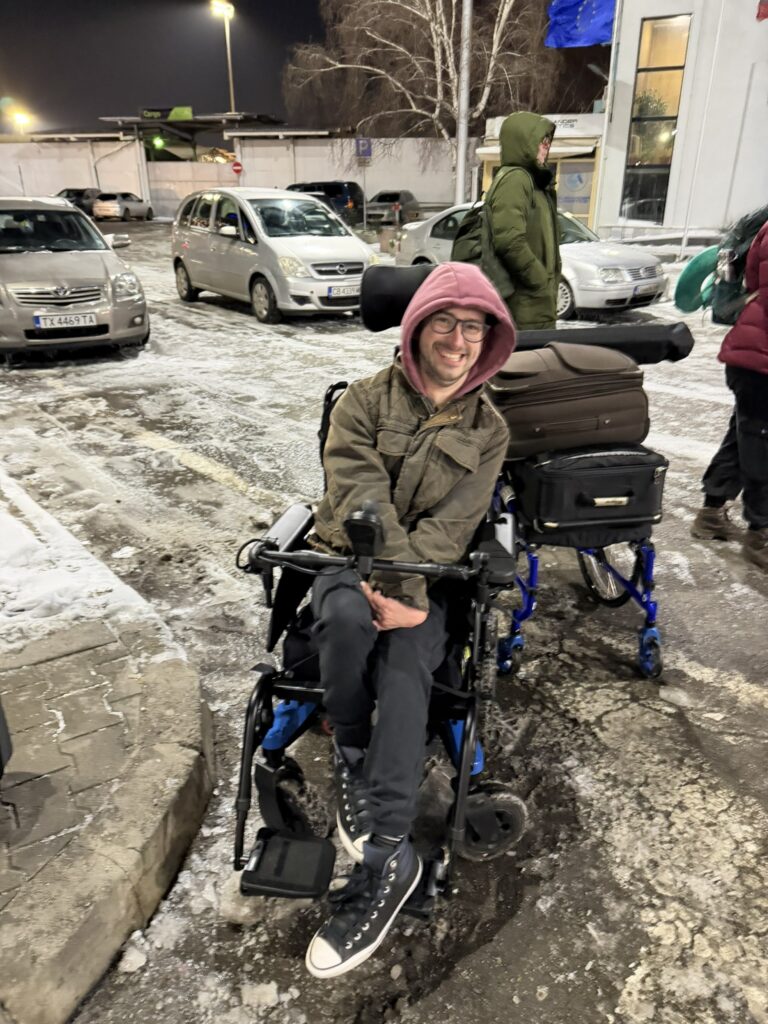
The next obstacle that one has to face is the ramp onto the bus. Although the bus can ‘kneel’, its ramp is designed to be used in conjunction with raised pavements to allow for level boarding. Of course, this isn’t possible when one is sitting on the road hence the gradient of said ramp is something to be desired.
T2 has been constructed fairly recently meaning that the terminal area and metro station is completely wheelchair accessible making for an easy transition…
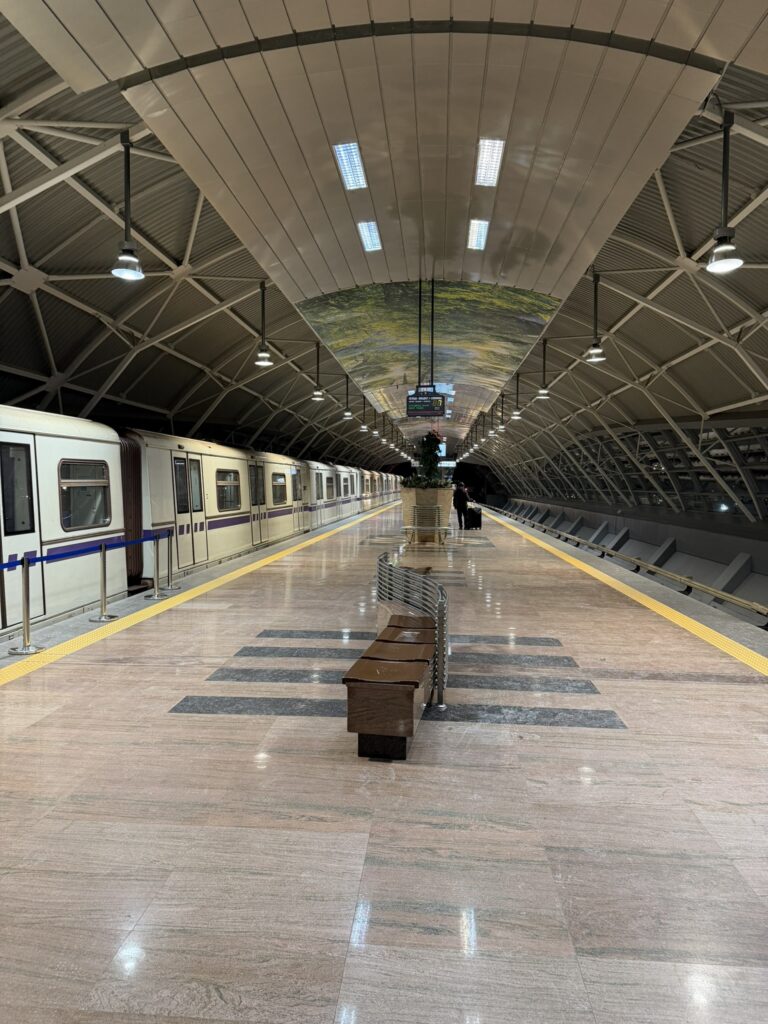
The cost of a ticket into Sofia city centre as of January 2026 is a mere 80 cents, what’s not to love!
Now, during planning of the trip, one discovered that a rather large step is present between the train and the platform, much too high for Superbunny2. It was time for the portable ramp…
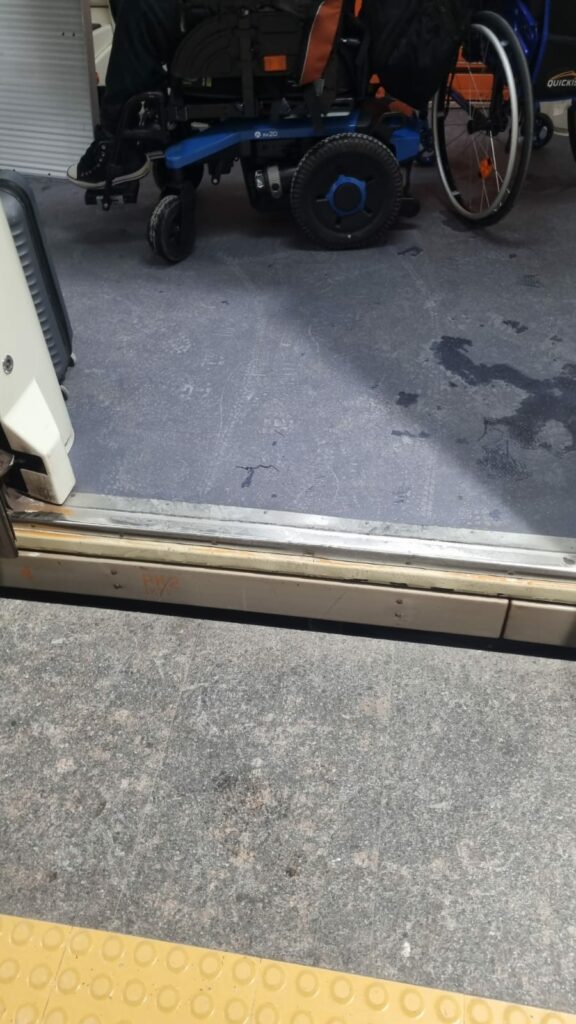
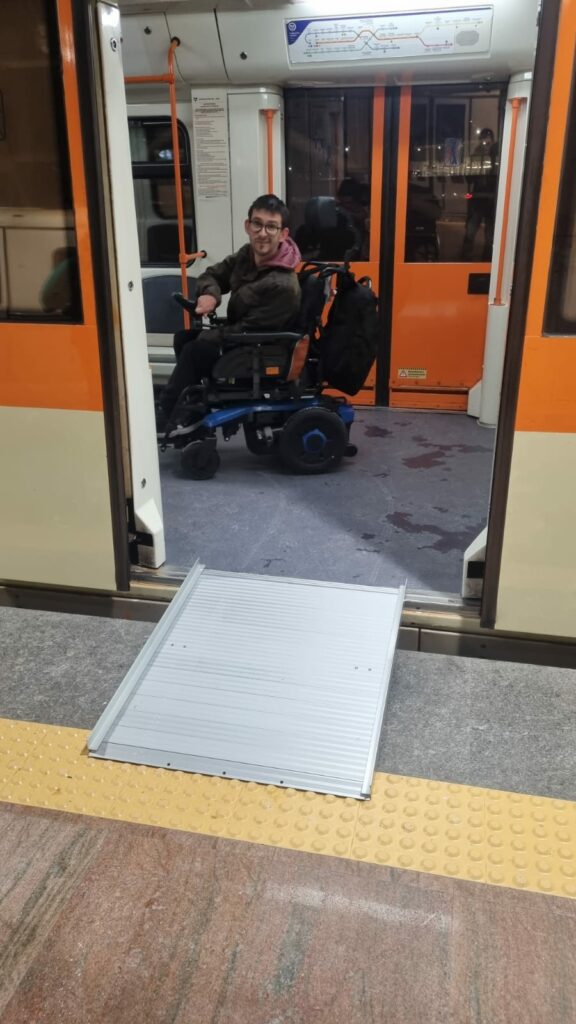
It is worth noting that all stations on the Sofia metro network possess elevators to street level hence if one can conquer said step, this is one of the most efficient ways to navigate the city.
As one is travelling by train to the city of Plovdiv in a few days, our hotel is located adjacent to Sofia Central Railway station which, of course, has it’s own metro station. The route to the hotel should be pretty straightforward for a wheelchair user thanks to the large underpass in front of the station thanks to multiple elevators. The only issue is that a large proportion of these do not work or have been set ablaze.
Let’s see how wheelchair accessible Sofia is for Superbunny2…